
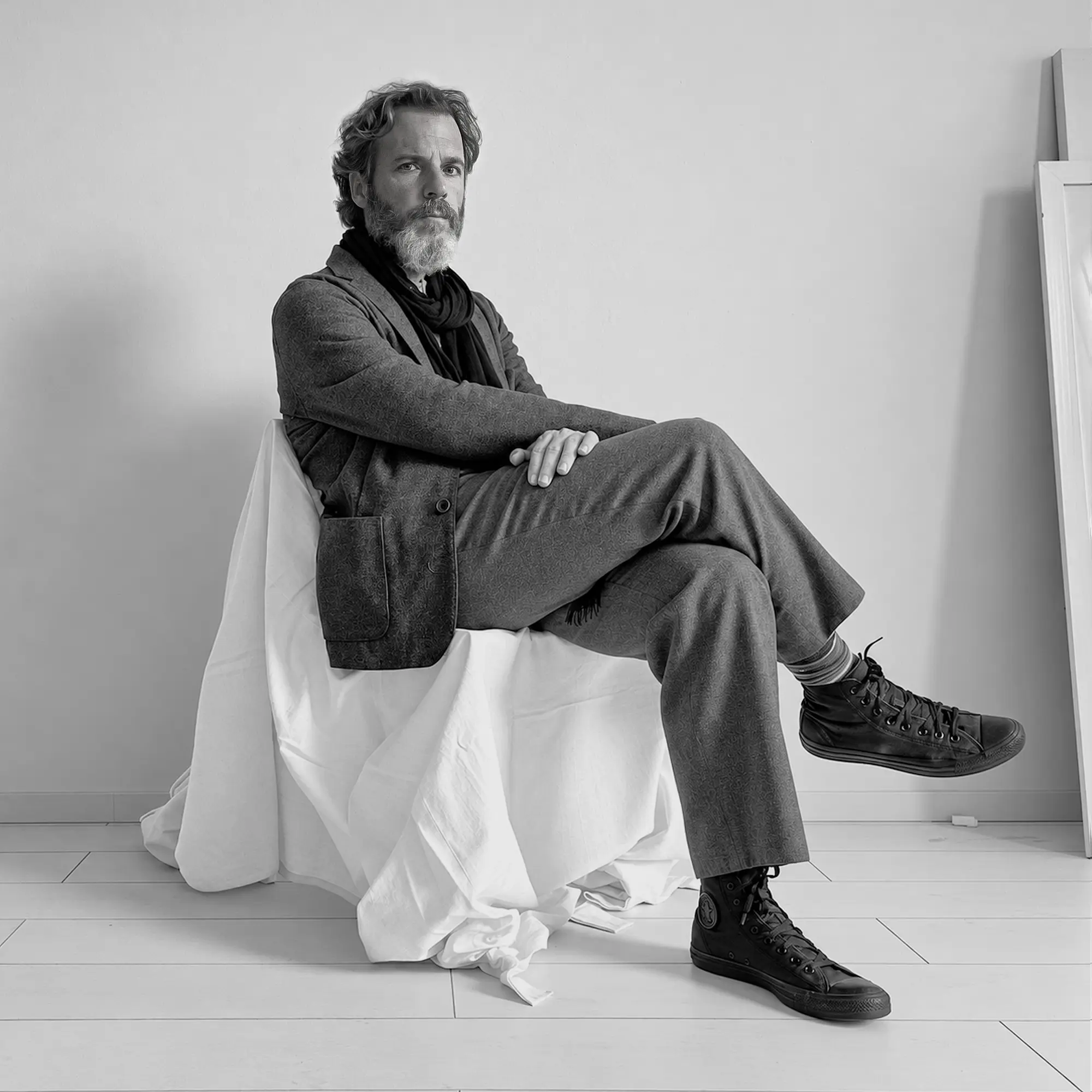
Martin Satí is a designer whose practice extends graphic thinking into objects, images and space.
About
Martin Satí is a designer and art director. He studied Fine Arts at the University of Seville and completed his education in Winchester, UK. Since the late 1990s, he has developed a practice centred on design, image-making and the construction of visual languages.
Throughout his career, he has worked for national and international companies and institutions including Apple, Google, IBM, Samsung, HP, AT&T, McDonald’s, Deloitte, Harper’s Bazaar, Osborne and Pink Lady, among others. This experience has shaped an approach rooted in composition, colour, experimentation and the ability to bring a distinctive visual language into very different contexts.
In recent years, his practice has gradually shifted from the image towards the object and space, developing works and interventions conceived in relation to architecture.
Martin Satí lives and works in Triana, Seville. Spain
Philosophy
His practice begins with graphic design understood as a method: ordering, relating, overlapping, separating, repeating and creating movement. A movement that extends into objects and space.
He is interested in the figure before it is fully resolved: when it emerges through the relationship between parts, voids, layers, colours and points of view. Rather than transferring an existing image into an object, he explores what happens when the rules behind its construction begin to occupy physical space.
Design thus becomes a structure for thought. It establishes conditions without fully determining the outcome. Between control and accident, each work retains a certain degree of instability: something that asks the viewer to look again, to shift position, or to mentally complete what is not entirely given.
His practice develops from this position, using the craft of design to construct images, objects and spatial relationships capable of keeping the experience open.
Haría solo una puntualización sobre una elección: he traducido «el oficio del diseño» como “the craft of design”, no como the practice of design. En tu caso me parece importante conservar craft, porque habla de conocimiento adquirido, oficio y método sin convertirlo necesariamente en artesanía. Además conecta perfectamente con la frase de cierre que ya tenías: “To use the craft of design without allowing it to close off the experience.”

Contact
martin@martinsati.com
...
Info
Terms and Conditions
Privacy policy
Copyright © 2026 Martin Satí.